
Simsbury City Directory Collections
Simsbury is officially a town, not a city. The historical inventory still uses local directory language for several printed resources covering the town and the Farmington Valley. Records appear by citation, publisher, and year. No complete annual run exists. Start with the official historic and architectural inventory. It cites the Hartford Little Suburban Directory for 1913 and 1915. It then names the Farmington Valley Directory for 1917, 1928, and 1932. That makes five discrete years, and a missing year between citations stays a gap rather than a promise of another surviving volume.
| Collection | Years | Where Held | Access |
|---|---|---|---|
| Hartford Little Suburban Directory, Clark-Delano Co. | 1913, 1915 | Official historic inventory citation; library or archive discovery | Locate the cited volume and inspect the original context |
| Farmington Valley Directory, Henry M. Meek Publishing Co. | 1917, 1928, 1932 | Historic inventory citation and local library/archive routes | Includes Avon, Canton, East Granby, Granby, and Simsbury |
| Connecticut Forest Service directory-style item | 1934 | Connecticut State Library digital collection | Simsbury heading with district, name and address, and telephone columns |
| Simsbury Free Library local indexes | Marriage circa 1849-1877; death circa 1847-1892; obituaries circa 1922-2006 | Free Library genealogy collection | Reading room, microfilm, indexes, and research-request route |
| Local Simsbury papers, MS025 | 1941-2018 | Free Library finding aid | Archive request by collection and row |
| Simsbury Free Library Quarterly name index | March 1994-Summer 2022 | Free Library online index | Name, date, issue, page, description, and subject lead to the original issue |
The table keeps printed directories apart from later finding aids. Newspaper and Quarterly records are not directory substitutes. They do extend the name trail beyond the cited printed years. The 1934 item is directory-style rather than a conventional household volume. Its OCR does not preserve row alignment. So no name can be safely paired with one address or telephone number. Every result needs a source date and a page or row. Add a note about what was actually viewed.
Simsbury's Discrete Directory Years
Clark-Delano Co. issued the Hartford Little Suburban Directory for 1913 and 1915. Henry M. Meek Publishing Co. printed the Farmington Valley Directory. That series covered a group of towns. Simsbury appears in its 1917, 1928, and 1932 volumes. The shift in title and publisher matters.
Copy each title exactly. Keep the publisher with the year. Never treat the Farmington Valley volumes as a Simsbury-only series. The citations open a local directory search, but they do not prove uninterrupted coverage from 1913 through 1932. A family listed in 1915 may vanish by 1917. An absent name can mean a missing volume, an indexing choice, a spelling change, or a move.
Search the cited years as separate snapshots. When an entry points to another town or a village label, keep that label in the notes before translating it into present-day Simsbury geography. Source discipline. Record the volume title, year, publisher, page, street spelling, and any abbreviation before comparing one year with another. That small record keeps the trail honest.
Simsbury Free Library Directory Shelf
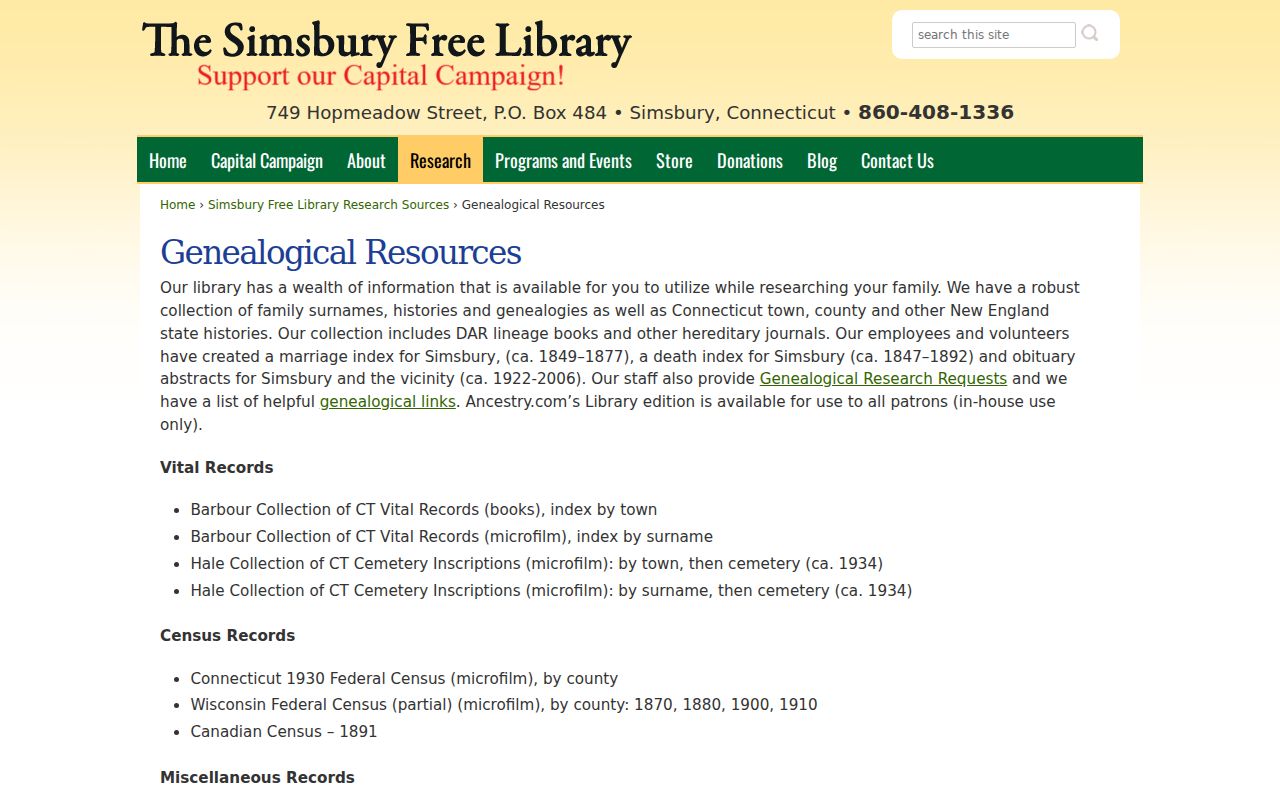
The Simsbury Free Library at 749 Hopmeadow Street, reachable at 860-408-1336, holds the deepest genealogy shelf in town. The reading room opens Tuesday and Thursday from 11 to 5. It adds the second and fourth Saturday from 10 to 2. Surname and family histories sit alongside Barbour Connecticut vital-record books and Hale cemetery inscriptions and microfilm. The shelf also holds Connecticut 1930 Federal Census microfilm, pension microfilm, and Bishop's Transcripts spanning the 1600s through the 1860s. Genealogical Research Requests are available by contact. The library publishes no fee, turnaround, or scope for that service.
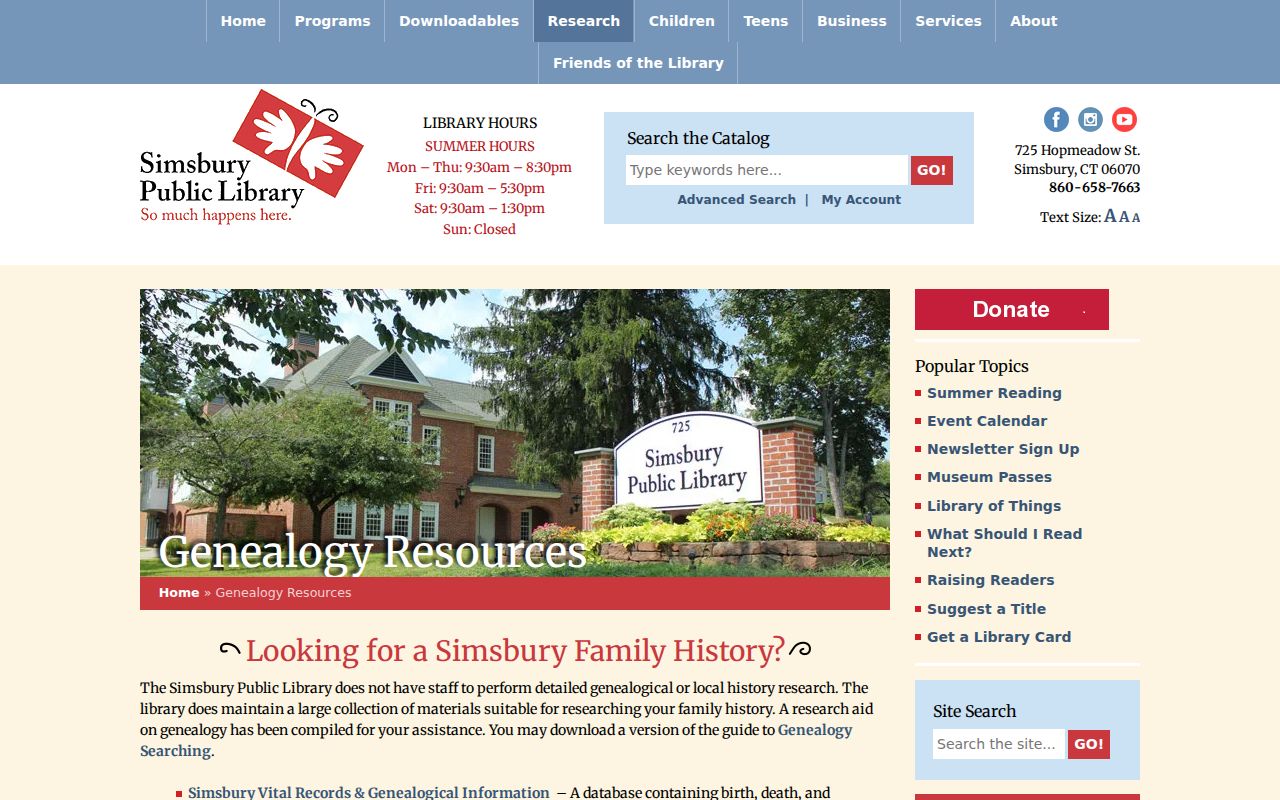
The Simsbury Public Library, at 725 Hopmeadow Street, 860-658-7663, offers a different route. Its local-history and genealogy guide points to the Simsbury Collection, historic homes and buildings, family histories, and in-library Ancestry access. One local vital and genealogy database is no longer updated. Staff do not promise detailed genealogy research. So treat a library database as a lead rather than a live register. Confirm current or certified events through the Simsbury Town Clerk or Connecticut DPH.
The Simsbury Free Library genealogy resources page lays out the local holdings. It also gives the practical route for asking about an older directory or related index.
A printed directory name works best in company. Pair it with a vital index, a cemetery note, a census frame, or a family history rather than reading the entry alone.
Reading a Simsbury Directory Entry
A 1934 Connecticut State Library item shows how a directory-style page can differ from a true household volume. Its local heading reads “SIMSBURY (Includes northern part of Avon, and West Hartford).” Three columns are visible: DISTRICT, NAME AND ADDRESS, and TEL. NUMBER. Names in the section include Stocking, Milton C.; Bonesio, Peter; Burnham, R. B.; Collins, Don; Eddy, McChesney; Hamig, Wm.; George, Amos; Osterling, A. L.; and Seymour, R. M. Those names help locate the right page. They prove little else. The OCR row alignment is unreliable. No address or telephone pairing should be asserted from text extraction alone.
| Local heading | SIMSBURY, with the stated coverage of northern Avon and West Hartford |
|---|---|
| District | The visible district column; retain the printed value and do not infer a modern neighborhood |
| Name and address | The combined column visible in the scan; inspect the image for the exact row |
| Telephone number | A separate visible column; OCR text does not safely preserve its pairing with a name |
| Source check | Use the scanned page, not an OCR line alone, before quoting a person, address, or number |
- Criss-cross directory
- An address-ordered directory that begins with a street and number and points to a person or household when that volume includes one. No separate verified Simsbury run was located.
- Householder index
- A name-first list of household heads or principal residents, usually used to find a page in a larger volume. The local research does not confirm a surviving Simsbury householder index.
- Abbreviation key
- The legend that explains short forms used by a volume. Photograph or transcribe it before reading entries, but do not assume every cited volume has the same key.
The Simsbury Public Library genealogy guide is a strong companion when a directory clue needs a local-history source. Its local database warning still applies.
Keep the image, page heading, and source title together. Notes built that way let a later researcher check the same entry.
Simsbury Quarterly Directory Index
The Simsbury Free Library compiled a name index for its Quarterly, running from the March 1994 first issue through volume 24 in Summer 2022. It covers every name. It is not a current resident list, and it is not a street-order directory. Each row shows Person Name, Date, Volume, Issue, Page Number, Article Description, Subject, and a View Issue link. Filtering, search, print, and export controls help. Sample rows include Adams Deborah, Adams Wm Jun., Allyn Luke, and Barnard Oliver. Those names show the layout. They claim no present-day connection.
Work from name to date, volume, issue, and page. Then open the original issue and its surrounding article, because the index line is only a pointer. One entry might lead to a local history piece, a family notice, a civic item, or an obituary reference. Only the issue supplies the context. Match the spelling and date. Compare the source-era place label with another record before the mention backs a household story.
For wider options, the Simsbury Public Library research databases page maps the library's database routes and the limits of its local historical material.
Use the database view for discovery. Then cite the original issue, page, or collection record that supports the conclusion.
Simsbury Newspaper Directory Clues
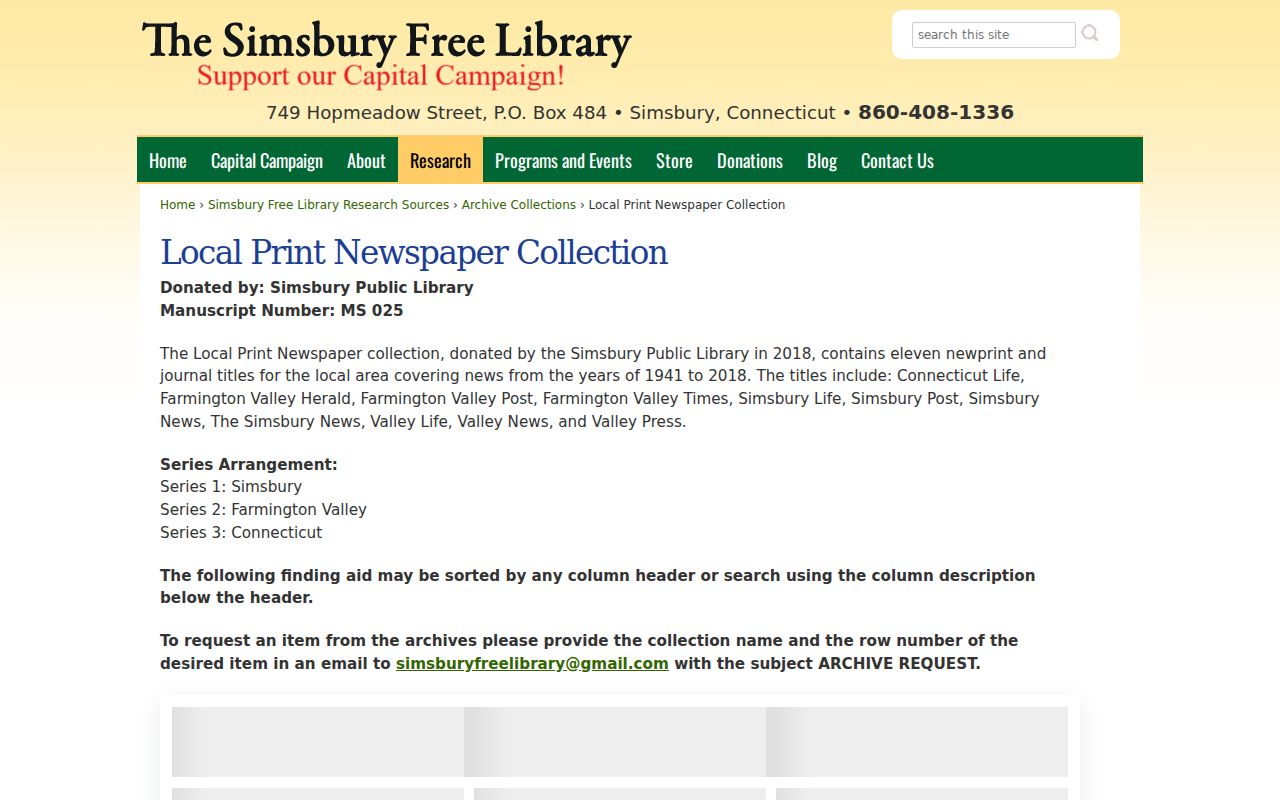
The Free Library's local newspaper collection, MS025, spans 1941 to 2018 across 11 titles. The roster runs from Connecticut Life and the Farmington Valley Herald to the Farmington Valley Post and Times. Simsbury Life, Simsbury Post, Simsbury News, and The Simsbury News appear too. So do Valley Life, Valley News, and Valley Press. The Public Library donated the collection in 2018. After printed directory citations, these pages can add obituary dates, civic notices, address clues, and family references. Coverage and spelling stay uneven, though.
Archive access works a specific way. Give the collection name and the finding-aid row, then email simsburyfreelibrary@gmail.com with ARCHIVE REQUEST in the subject line. Ask for the exact row. An unbounded name search will not get far. For institutional context, the Ensign-Bickford MS004 finding aid covers 1851 to 1980 in 356 rows, preserving material that survived an 1851 fire. Fields show row number, series, description, start, end, notes. The Simsbury local papers finding aid lays out the archive route for newspaper rows that can bridge gaps between directory years.
A newspaper clue grows stronger with three pieces. The original item, a firm date, and a second local source should all point to the same person or address.
Simsbury Directory House History
The Historical Resources Inventory adds a physical layer to a Simsbury directory search. Fields cover name, location, ownership, use, construction, style, integrity, and significance. A house entry earns its keep fast. It can separate two people with similar names. It can also explain why a directory address changed form over the years. The inventory cites Sanborn maps for Simsbury in 1923 and 1940. Those maps are not people directories. What they show is a building footprint, its use, nearby streets, and structure context. That tests an old address against today's parcel.
Keep the address, village label, and legal description apart. Sources may say Simsbury, Weatogue, Tariffville, West Simsbury. Older settlement names appear too. Terry's Plain, Hop Meadow, Hoskin's Station, and East Weatogue all show up. Never silently rewrite one label as another. Record the source-era wording first, then compare the historic inventory, map context, deed description, and current parcel.
The Simsbury Historical Society at 800 Hopmeadow Street holds archives by appointment; reach it by email or 860-658-2500. Tours run Thursday to Saturday. From mid-April through mid-October, Phelps Tavern guided tours start at 1:00 and 2:30. The Visitors Center and gift shop keep Thursday-to-Saturday hours, 12 to 4, year-round. Those hours serve an in-person archival question, not a promise that a given directory volume survives.
Trace Simsbury City Directory Years
Trace a household as a dated sequence across the surviving years. Do not force a smooth story. The goal is honesty about evidence. Show which source places a name at an address. Show which one only suggests a link, and where the record trail breaks. The National Archives census guide covers 1790 through 1950 under the 72-year release rule. The Free Library holds Connecticut 1930 census microfilm for local use.
- Write the person's name, street spelling, village label, and the exact directory year. Preserve initials and abbreviations.
- Check the cited 1913, 1915, 1917, 1928, and 1932 volumes as separate points. Note the title, publisher, page, and printed address.
- Pair each directory point with the nearest available census year, starting with the matching household and enumeration area rather than assuming the same address format.
- Use the Free Library indexes, Quarterly issue context, newspapers, cemetery material, or the house inventory to test identity, family links, and address changes.
- Mark an absence as unproved. Ask the library, Historical Society, or State Library about a missing volume before calling a person a mover, death, or unlisted household.
The National Archives naturalization guide explains that no central index exists. Before September 27, 1906, local and federal courts could both naturalize. Later Connecticut federal material routes through NARA Boston. Naturalization is a supporting identity clue. It is not a printed directory replacement. So lean on the name variants, residence, origin, and dates the record request route supplies.
Simsbury Town Records, Not City Records
Search engines say "city directory," but Simsbury's legal government is a town. Hartford County supplies the geography. Connecticut has had no county seats or county clerks since county government ended in 1960. The practical records office is the Simsbury Town Clerk at 933 Hopmeadow Street, 860-658-3243. Custody there spans land records, maps and surveys, birth, death and marriage records. It also covers election and referendum results, voter registration, military discharges, ordinances, meeting minutes, trade names, and notary appointments.
That distinction matters whenever a directory clue needs current verification. Route eligible events through the Town Clerk or the Connecticut DPH vital-records route. Skip any assumed county office. Property cards and map layers add property-associated names and context, though they never establish occupancy. A historical directory starts the inquiry. The proper custodian answers the narrower question that follows.
Simsbury's Burned Records Story
Simsbury’s early record gaps have a documented cause, not a mysterious one. The town history reports records from the first ten years. They were accidentally burned in 1680. A darker loss came earlier. The historic-district handbook describes a March 26, 1676 attack in East Weatogue. It destroyed roughly 40 dwellings, barns, and outbuildings. An early absence therefore says something about preservation, not about whether a household existed.
Settlement clues cluster in Terry’s Plain, Hop Meadow, Hoskin’s Station, Weatogue, and East Weatogue. The same history gives these locations. By 1710 it counts about 50 houses along both sides of the river. A family-history search in Simsbury often needs deeds, church or cemetery material, and maps. Later printed directories matter too. State the loss. Cite the surviving source. Stop where the evidence stops, because a careful gap beats a made-up continuous line.
Note: The official inventory, libraries, and Historical Society show where sources are held, but no complete annual Simsbury directory run or clean 1917 facsimile survives among them.